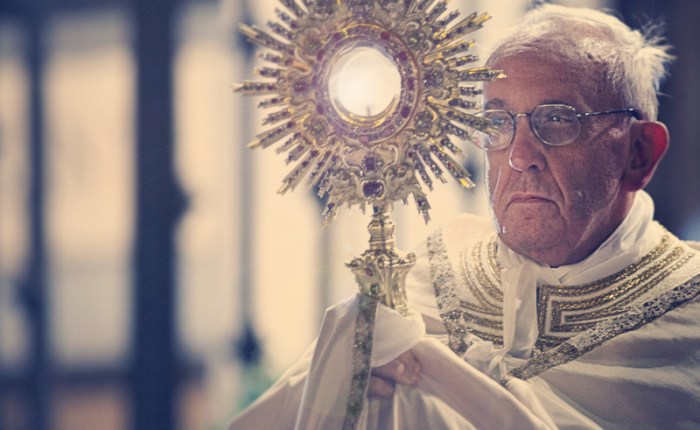
Corpus Christi

Corpus Christi

I like to think if I were a follower of Jesus in his earthly ministry I would have been able to pick up on the pattern:

  1. Jesus encounters people suffering and in need
  2. Jesus performs a miracle and meets their need
  3. Jesus gives us a teaching about who He is and why He is here among us

I’m smart like that.

So when Jesus multiplied the loaves and fishes to feed 5,000 men, not counting women and children, I’d knowingly look over at one of my apostle friends and smile, “Watch this Bartholomew, now he’s going to say something awesome.” This time is a little different though. This time Jesus goes to pray alone while we all pile into a boat and cross the sea (just an aside, there was a huge storm and Jesus walked on water to us. No big deal).

The next day all the people come across the sea to where we are. They’re curious, seeking and excited. I see what you did there Jesus. Make them wait a day and come to you. Nice touch. John, get ready to write this down.

“Truly, truly, I say to you, it was not Moses who gave you the bread from heaven; my Father gives you the true bread from heaven. For the bread of God is that which comes down from heaven, and gives life to the world…I am the bread of life; he who comes to me shall not hunger, and he who believes in me shall never thirst.”

Well played Jesus. We should hunger for a relationship with you and thirst for righteousness like we hunger and thirst for food and water! Still, these new disciples are taking your analogy a bit too literally. Maybe you should clarify?

“I am the bread of life. Your fathers ate the manna in the wilderness, and they died…I am the living bread which came down from heaven; if any one eats of this bread, he will live forever; and the bread which I shall give for the life of the world is my flesh.”

Lord, that might be taking things in the wrong direction. See, the people are confused because they think you mean this “eating and drinking” literally. If you explained that this is just a metaphor for meditating on your teachings or that its symbolic of learning to share better that might help.

“Truly, truly, I say to you, unless you eat the flesh of the Son of man and drink his blood, you have no life in you; he who eats my flesh and drinks my blood has eternal life, and I will raise him up at the last day. For my flesh is food indeed, and my blood is drink indeed. He who eats my flesh and drinks my blood abides in me, and I in him.”

Now the people are leaving. “This saying is too hard. Who could believe it?” Jesus, call them back! Tell them it’s all an analogy! It is all an analogy, right? You wouldn’t let people leave you because they couldn’t understand a metaphor, would you?

Now Jesus looks at us. At me.

“Do you wish to leave also?”

Peter speaks up, “Lord, to whom shall we go? You have the words of eternal life; and we have believed, and have come to know, that you are the Holy One of God.”

This changes everything.

Because Jesus isn’t some ancient teacher whose wise words remain with us today.

He is with us today.

In the Eucharist we can actually know the risen Jesus—not a long dead historical figure. He is alive and wants an intimate and eternal relationship with you and me.

Our God comes to us in the appearance of simple bread and simple wine. The Body, Blood, Soul and Divinity of Jesus Christ are really and truly present in the Eucharist we receive, because that is the promise He made.

The Holy One of God, for whom and through whom all things were made, desires to dwell within you and me.

His grace transforms us. We become what we eat and, by this Eucharistic miracle, Jesus abides in us.

“When you approach the tabernacle remember that God has been waiting for you for twenty centuries.”

-Saint Josemaría Escrivá
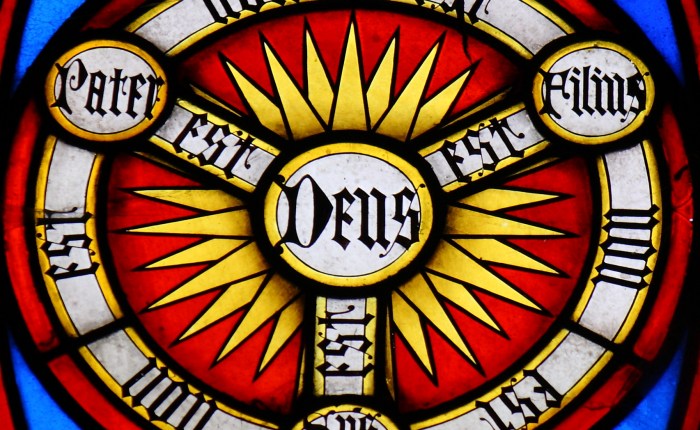
Glory to the Father, the Son, and the Holy Spirit

Glory to the Father, the Son, and the Holy Spirit

The other night Katie and I were having one of those important, deeply profound, life changing, heart to heart conversations. This one in particular was about who Hollywood director Judd Apatow is married to. Is it Jenna Fischer? No, Isla Fisher? At some point one of us said “Why are we discussing this, let’s just Google it and be done.” It’s Leslie Mann, if you’re wondering. Google is great for that. Often times friends or family will be sitting around having trivial conversation and a question will come up that just has to have an answer right now. So someone grabs their phone and Googles it, problem solved. I think that’s fine when dealing with trivia. But there’s also a temptation to that same “problem solved” mentality with nontrivial things. The success of the scientific method and the technologies science produces has led us to conclude that everything is merely a problem that can be solved. But not every truth has a simple summation that our intellect can grasp.

We have a beautiful word for these Truths that can’t be simply summed up or solved—mystery. I used to think calling something a mystery was a graceful way of admitting ignorance of a thing that should be understood but wasn’t. Mystery is so much more than that. A mystery is not something that can’t be known at all, it is something that can’t be known completely. The central mystery of the Catholic faith is the Most Holy Trinity. Scripture is pretty clear on four things:

     The Father is God (Philippians 1:2)

      Jesus is God (Titus 2:13)

     The Holy Spirit is God (Acts 5:3-4)

     There is only one God (Deuteronomy 6:4; 1 Corinthians 8:4)

We first learn this truth by various analogies, though none of them are the complete truth. The temptation to apply a problem solving sort of “Google it and be done” approach to the Trinity is much older than Google. Oversimplifying the truth to make God more manageable can lead to a number of material or accidental heresies, some of which I have been guilty of believing in the past. Here’s a short list of Trinitarian heresies:

Sabellianism: God is one person, but reveals himself to us in three different ways. For example, a man is one man but also a father, a husband and an employee. However, this heresy denies the Threeness of God. Another example: H2O is water, ice and vapor.

Arianism: The belief that only the Father is truly God and that the Son and the Holy Spirit are his creations. The sun is a common example: the sun represents the Father, and the sun’s light and heat represent the Son and the Holy Spirit.

Tritheism and Partialism: Tritheism is the belief that the Father, Son and Holy Spirit are actually three gods who work as one. Partialism is the belief that the Father, Son and Holy Spirit are three parts or divisions of God. A common example of partialism is the shamrock (sorry Saint Patrick). Another is an egg—one egg made of shell, yolk and white.

The mystery is that God is one nature and three distinct Persons. The Father is not the Son or the Spirit. The Son is not the Father or the Spirit. The Spirit is not the Father or The Son. The three Persons share one divine substance (consubstantial).  The Father is God. The Son is God. The Holy Spirit is God. I really hope that makes very little sense to you as it makes very little sense to me. Because the tension created by this mystery is beautiful.

I was one of the six people who bought a Wii U. I used it a lot when I first purchased it. It was fun to figure out its features and get new games to play on it. But then I had it all figured out and it became boring to me. It was, after all, just an object. Persons are not objects and we can’t fully know them simply by knowing about them. That would be like thinking you know someone because you know their name, favorite movie and where they see themselves in five years. The greatest aspect of being in relationship with another person is the mystery that they are so wonderfully other.

Our God is not just one Person but three Persons equal in glory, coequal in majesty. We could (and hopefully will) spend an eternity coming to share in the inner life of the Trinity and never reach its depths—never fully grasp the mystery, and never grow bored. If you’ve ever been blessed to read a book (or binge-watch a series on Netflix?) that pulled you in and totally engrossed you and you never wanted it to end then you might understand this. If you’ve ever had a deeply meaningful conversation that lasted hours but felt like minutes that’s even closer. But books and people are finite. We have to avoid the temptation to make God a problem to be solved or a question to be Googled—small and understandable. I hope this Trinity Sunday finds you diving into the reality of a God who is deeper than we can imagine, beyond comprehension and beckoning us all to enter into the perfect communion of life and love that is our God —the Father, the Son and the Holy Spirit.

I arise today through a mighty strength, the invocation of the Trinity, through belief in the Threenessthrough confession of the Oneness of the Creator of creation.”

-Saint Patrick

Happy Birthday Church!

Happy Birthday Church!

I love the Holy Spirit. He is amazing. We are taught that the Holy Spirit is the Love between the Father and the Son. I used to marvel at the idea that the love between two Persons could be so powerful that another distinct Person could proceed from that Love. I still marvel at that reality despite participating in it and seeing not one but two persons proceed from the love between Katie and me. I’ve also been blessed to have the veil lifted at times to see something powerful proceed from the love between a father and son.

On the day Caleb was born, after spending some bonding time with mom, I went upstairs with him to the nursery where they did tests and took measurements. I remember standing there, looking down at Caleb with something new but familiar burning deep in my chest. There were certainly many emotions, as one might expect when a child is born. This particular birth was made a bit more emotional because we had just observed the 9th anniversary of our oldest child’s death. But this burning love inside as I looked at Caleb wasn’t just a feeling. It was like love stepped out of mere sentiment and showed what it truly was—a pure fire of will, totally unencumbered by fickle emotion. I borrowed a line from our Heavenly Father, “This is my beloved son, with whom I am well pleased.” I have had that same burning many times these last nine months.

I had it this morning as I left for work. Caleb was playing on the floor. I got down on all fours and put my forehead against his. I said, “I love you Caleb Maximilian, be good to mom today.” He grabbed my beard and gave me a sloppy drooly kiss (he’s still working on his technique). The burning in my heart returned once again. On my drive to work I thought about how the more emotional side of love was tugging at me to stay home, but the burning fire of will was urging me to go out. It calls me to go places and do things that are uncomfortable. Love as a function of the will is unselfish and agenda free.

This love, perfect and infinitely multiplied, is the Love from which the Holy Spirit proceeds. When we become docile to the Holy Spirit and remove obstacles to personal holiness miracles happen. Mary said yes to the overshadowing of the Holy Spirit and the Son of God became man. When we allow the Holy Spirit to overshadow us Christ enters the world through us. Two thousand years ago, on the first Pentecost, a group of insignificant socio-economic nobodies received the Holy Spirit and, led by a wayward fisherman, brought the One, Holy, Catholic and Apostolic Church into the world. That same Holy Spirit dwells in us. That same burning fire of Love urges us out of complacency to the same bold, fearless faith.  What better gift can we give to the Church on her birthday than to echo Mary’s “Yes” to the Holy Spirit?


On This Day, O Beautiful Mother

We are the Pilgrim Church on Earth, journeying towards our universal Home. This image of a pilgrim church at sea is reaffirmed in the design of our church buildings. The main body of the church is called the “nave” from the Latin word for ship (think “naval”).  Look up at the ceiling of the church and with little imagination you can see an inverted hull. This beautiful analogy gives us a sense of the common mission and destination of the Roman Catholic Church as well as the common calling of our own parish. I think the analogy can also be extended down to the level of our domestic churches—our families. Like the passengers and crew of a ship we raise the sails, swab the deck and keep a lookout for anyone who may have fallen overboard always with an eye toward our final goal in Heaven.

In this analogy I think the role of Motherhood is found, more than anywhere else, in the sails.   Jesus talks about the Holy Spirit being like the wind, which blows and we do not know its source or aim. When the Holy Spirit came upon the disciples at Pentecost there was a rush of mighty wind. The sails receive the wind and deliver its driving force through the mast to the whole ship. Sails are a paradox. They have to be soft enough to embrace the wind yet firm enough to transmit its power. Without sails the ship is dead in the water and so is the family without its life giving mother.

This was my experience growing up. Dad was head of the household, and Mom’s embrace of his headship gave life to it, just as she gave life to my brother and my sister and me. Her discipline came through expressing disappointment, which stung more than any punishment or grounding. She was always there to listen, even when I wasn’t saying anything worth listening to. Mom was the one I went to when I needed wisdom, counsel or courage. Most of all she was the one I went to when I needed unconditional love. A mom’s love is the definition of gift of self. It’s fitting that Mother’s Day so often falls near the Pentecost. Just as the Holy Spirit is poured out on us (Joel 2:28) a mother’s love and very life are poured out on her children.

God doesn’t limit good things. He multiplies them. My biological mother is not the only mother He gave me. I count no less than five. He gave me my birth mother. He gave me His own Blessed Mother from the cross. He gave me Holy Mother Church. He gave me a wonderful mother-in-law. And of course He gave me an amazing wife, who is mother of my children. There are countless other women who have been spiritual mothers to me all throughout my life. Mother’s day is an opportunity to say thank you and reflect on these remarkable women—sails that embrace and empower. By their example of sacrificial love, mothers bring us to Jesus Christ.


Behold, I Make All Things New

I remember the first time I saw the film “The Passion of the Christ.” It was such a powerful and at times difficult experience to watch Jesus suffer for love of us. About halfway through the movie, as Jesus is carrying His Cross to Golgotha, He falls for the second time, and there to greet him is the Apostle John and Mary, His Mother, with a look on her face that says, “Why must you do this, my Son?” In the film His reply is paraphrased from Sunday’s second reading; “See Mother? I make all things new.” With that he takes up the cross and carries onward to Calvary.

Jesus speaks these words from His heavenly throne the end of Revelation, the last book in the Bible. The scene is the resolution of a story that began way back in the Garden of Eden. We have a tendency to think of Heaven as a different place—that upon death our souls leave our bodies behind and go to a different and better place than the here and now. The Book of Revelation shows us something quite different. Jesus, by his Passion, Death and Resurrection, has made and is making all things new again. We aren’t going to Heaven, Heaven is coming here. Everything God created is good (Genesis 1:31) and was made for eternity, including you and me. Although, nothing will enter eternity without first being transformed.

This matters to us beyond mere theological accuracy. It is a practical truth. “Behold I make all things new” reminds us that all things will be made new. Imagine what it must be like to live in a world where everything is a sign pointing to a heavenly reality. Christ’s promise to make all things new again is a promise that all of creation is just such a sign. We need to learn to stop looking at things and start looking along them. There is wisdom to be found here regarding what it means to be a part of this creation. We are all destined to be made new in Christ. All people can be made new and are redeemed by Christ. No one is too broken or too lost.  This should have a profound effect on the love we show to each other (Jesus’ command in this Sunday’s Gospel) for it demonstrates our true worth in God’s eyes.

“There are no ordinary people. You have never talked to a mere mortal. Nations, cultures, arts, civilization—these are mortal, and their life is to ours as the life of a gnat. But it is immortals whom we joke with, work with, marry, snub, and exploit—immortal horrors or everlasting splendours.”

-C.S. Lewis

The New Evangelization

What comes to mind when we hear the term “New Evangelization?” Some have never heard the idea of a New Evangelization. What’s wrong with the old evangelization? For others, they’ve seen this term being thrown about in various circles and a number of images come to mind: new and improved Jesus! Catholicism 2.0! Or is it, and God forbid (literally), a cynical marketing ploy from a 2,000 year old church struggling to remain relevant? It is probably a good idea to clarify just what the New Evangelization is and what it means to our community of faith. In doing so I hope to share with you all just what it is my new role will hopefully mean for the future of our parish.

What is the New Evangelization? It most definitely is not new and improved Jesus, after all you can’t improve on perfection. It is not Catholicism 2.0. Jesus promised Peter that the gates of hell would not prevail against His church—the Catholic Church. We’re still on Plan A and there is no Plan B. As for an attempt to remain relevant, I can’t see anything more relevant than the answer to life’s great questions: Who am I? For what purpose was I made? Is there more to life than meets the eye? Jesus Christ will remain relevant to this world regardless of our efforts because this is His world. He doesn’t simply provide answers to life’s most important questions; He is the answer to life’s most important questions.

The Good News is the same as it ever was.  “But the angel said to the women, “Do not be afraid; for I know that you seek Jesus who was crucified. He is not here; for he has risen, as he said. Come, see the place where he lay. “(Mt 28:5-6) Christ is risen. Death has died. Sin has no power over us anymore.

Because of this euangelion (“good news” in greek) we who are baptized are all evangelists. We are all missionaries. Each one of us is called to declare to the whole world the Good News by word and deed. “Go therefore and make disciples of all nations…” (Mt 28:19-20) This is the duty of all baptized Christians.

The newness of the the New Evangelization doesn’t refer to the message itself. The New Evangelization is “new in ardor, method and expression” (Saint John Paul the Great’s Address to the Latin American Episcopal Conference (CELAM), March 9, 1983). I would like to back up a little and explain why this is so necessary for bringing people to Jesus. Saint John Paul identifies three scenarios in which evangelization takes place:

  1. To people who have never encountered Jesus Christ or the church. This is what most people might think of when they hear about evangelizing and mission work. Worldwide there are billions of people who have never heard of Jesus or the good news. To them is the mission ad gentes (to the people).
  2. Christian communities that are practicing believers who “bear witness to the Gospel in their surroundings and have a sense of commitment to the universal mission” of the Church. This is the lifelong faith formation which consists of evangelization (spreading the faith), catechesis (teaching believers) and apologetics (defending the faith). We do this as a parish and principally at home in our families.
  3. An intermediate situation “where entire groups of the baptized have lost a living sense of the faith, or even no longer consider themselves members of the Church, and live a life far removed from Christ and his Gospel.”

It is in this 3rd scenario that the New Evangelization is called for. In his encyclical Redemptoris Missio (Mission of the Redeemer) Saint John Paul the Great declared, “I sense that the moment has come to commit all of the Church’s energies to a new evangelization and to the mission ad gentes. No believer in Christ, no institution of the Church can avoid this supreme duty: to proclaim Christ to all peoples.” (3)

While the overwhelming majority of people in the world have never heard the Gospel message, the same cannot be said for where we live. I believe Saint Mary of the Hills does a wonderful job at catechizing and evangelizing our own parishioners. But what of those Christ has entrusted to us bring the good news? In our very neighborhoods we see that religious service attendance hovers below 20%. Many people have heard the good news and remain indifferent to Jesus’ invitation. The new “ardor, method and expression” of the New Evangelization is a recognition of this reality.

Discussing matters of religious faith with family, neighbors, friends and co-workers is usually on the list of favorite activities somewhere right between “Getting a Root Canal Without Anesthesia” and “Going To The DMV” or maybe even “Explaining Snapchat To Anyone Over 30.” Pope Francis has echoed the call for a new evangelization in the secularized west noting that there is difficulty in carrying out this work. “The process of secularization tends to reduce the faith and the Church to sphere of the private and personal…it has produced a growing deterioration of ethics, a weakening of the sense of personal and collective sin, and a steady increase in relativism” (Evangelii Gaudium 64). Our world has received a small portion of the gospel message—all too often delivered in a joyless way that acts as a vaccination against catching the “good infection” that our faith is.

He later includes this appeal to Catholics:

“Who would claim to lock up in a church and silence the message of Saint Francis of Assisi or Blessed Teresa of Calcutta? They themselves would have found this unacceptable. An authentic faith – which is never comfortable or completely personal – always involves a deep desire to change the world, to transmit values, to leave this earth somehow better that we found it.” (Evangelii Gaudium 183)

For us who are blessed to receive Jesus in the Eucharist there is a strong call to the mission to evangelize. Saint John Paul said, “Communion and mission are profoundly connected…communion represents both the source and the fruit of mission: communion gives rise to mission and mission is accomplished in communion.” (Christifideles Laici 32) The new evangelization is an answer to the call to mission with a renewed sense of urgency. The Holy Spirit is moving in new ways through the Church and we are blessed to be participants in His work. Programs related to the new evangelization are first and foremost about strengthening our own relationship with Jesus. When we come to believe that he is the Christ, the center and meaning of our lives, we will have a desire to share Him with others. There will be plenty of opportunity to learn how to evangelize in everyday life with and without words. Most especially, how to have breakthrough conversations with others when our example of “love, joy, peace, patience, kindness, goodness, faithfulness, gentleness and self-control” (Gal 5:22) has brought someone to believe that we have something (or Someone) that they too want.

We know Jesus. We know “the peace of God, which surpasses all understanding (Phil 4:7). We receive his Body, Blood, Soul and Divinity in the Eucharist. We receive healing and absolution in the sacrament of Reconciliation. We are adopted sons and daughters of our “Abba,” our Father, through baptism and confirmation.  To know Jesus Christ is to know unspeakable joy. It is my great hope that by answering this call to the New Evangelization we can, all of us, be bold in our love for Christ and passionate in our desire to lead others to Him. “Behold, I am doing a new thing; now it springs forth, do you not perceive it? I will make a way in the wilderness and rivers in the desert.” (Is 43:19) He is doing something new through Saint Mary of the Hills to enliven the spiritual desert that has grown around us.